

Alberta's transportation minister judged Edmonton's requests to bring back speed cameras at eight of its most dangerous intersections against rules he signed while the applications sat waiting, and that the city never saw until after the decisions came back.
That's according to an update City Administration sent council on Nov. 6, after meeting with provincial officials. The province approved one intersection, rejected four, and told the city it didn't know the other three applications existed.
The rules Edmonton followed
Alberta all but banned photo radar on April 1, 2025. Speed-on-green cameras at intersections were switched off, but municipalities could ask the province for exemptions at specific high-risk intersections, based on hard data and published criteria.
Under the 2025 guideline, an intersection qualified with 50 or more collisions a year, or evidence of deaths or serious injuries, or at least twice as many collisions relative to traffic as similar sites. The city also had to show what other safety measures it had already tried.
Between November 2025 and January 2026, Edmonton used those rules to apply at eight of its worst intersections. Edmonton police signed off on all eight.
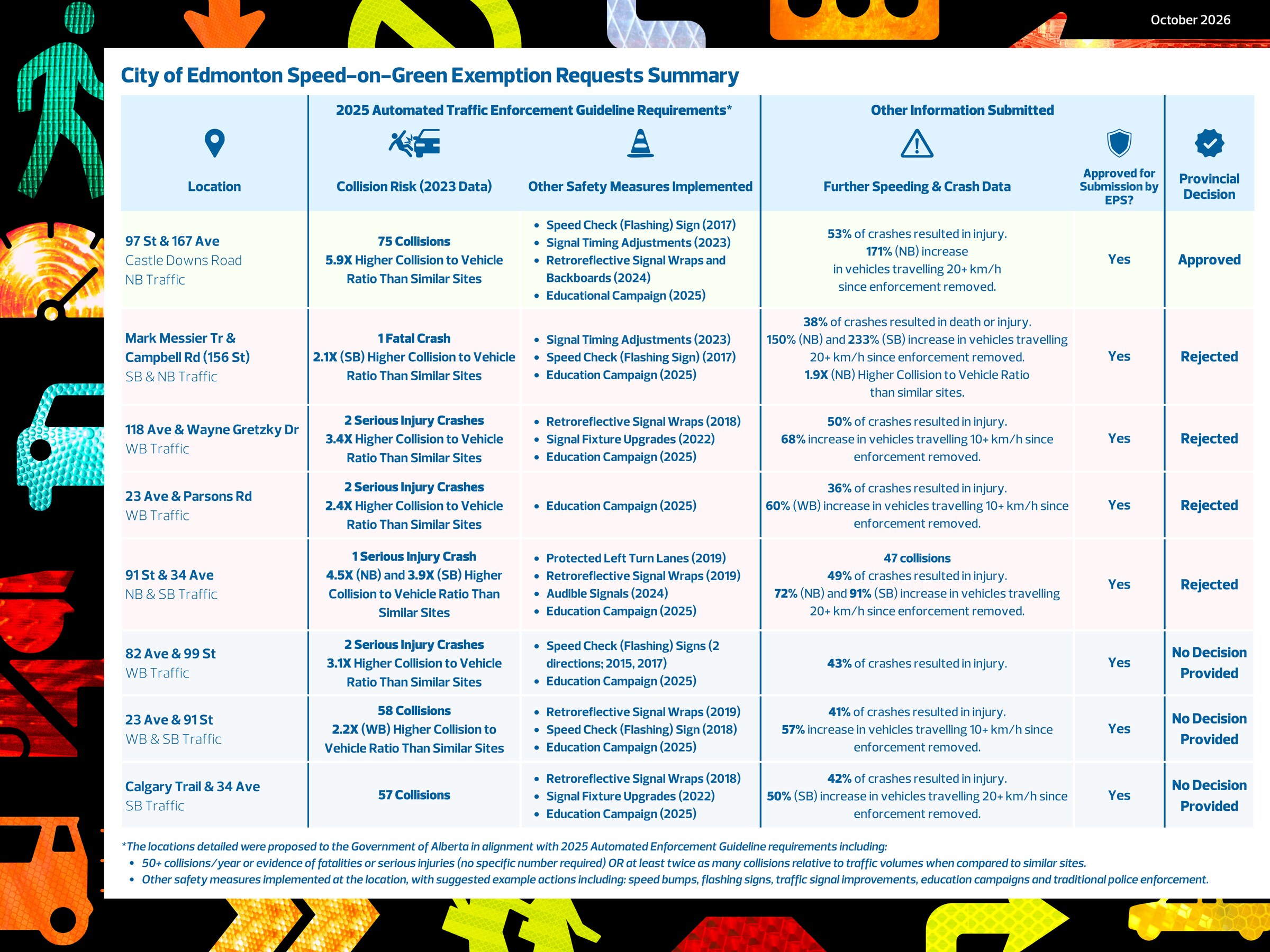
The City of Edmonton's summary of its eight applications, prepared for council in October 2026.
New rules, signed while the applications waited
In September, with those applications still waiting on a decision, Dreeshen picked up a pen and signed brand new rules: the Pilot Project (Automated Traffic Enforcement) Regulation.
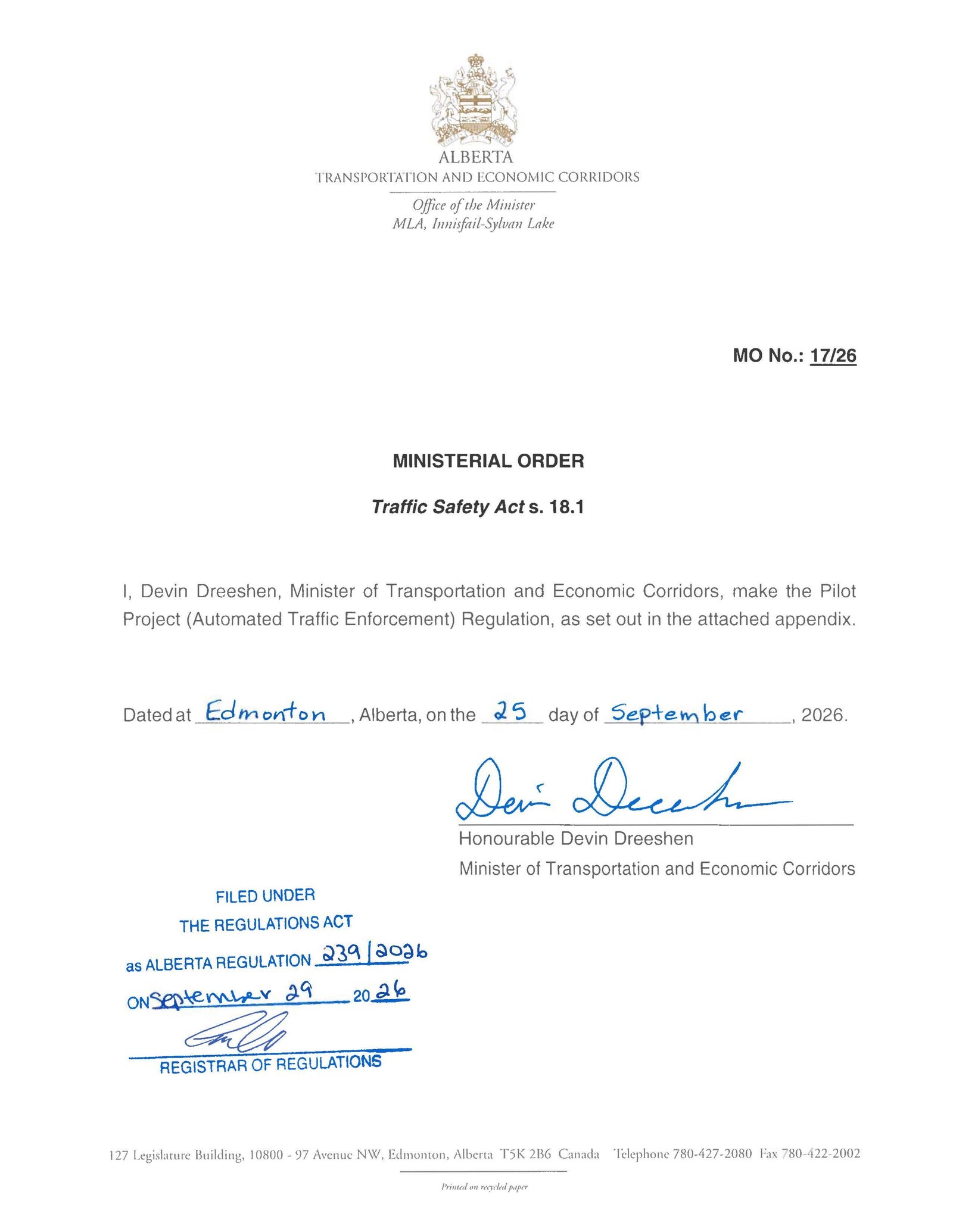
Ministerial Order 17/26, signed by Dreeshen on Sept. 25, 2026.
-
2025
April 1: photo radar is restricted. Speed-on-green ends; cities can apply for exemptions under the 2025 guideline.
-
2025
November to January 2026: Edmonton submits eight applications, all approved for submission by Edmonton police.
-
2026
Sept. 11: the new regulation is drafted (the date stamped on the filed copy).
-
2026
Sept. 25: Dreeshen signs Ministerial Order 17/26. It's filed as Alberta Regulation 239/2026 on Sept. 29.
-
2026
Oct. 15: the regulation takes effect.
-
2026
Oct. 16: Edmonton gets its decisions. One approved, four rejected, three with no decision.
-
2026
Late October: the province posts the new criteria online.
-
2026
Nov. 6: provincial officials confirm the applications were judged against the new rules.
He didn't tell municipalities, and the new criteria didn't go up until after he'd used them. Here's how the city's deputy city manager put it to council:
Guidelines used to evaluate applications: Provincial officials confirmed that Edmonton's applications were evaluated against new 2026 criteria, rather than the published 2025 guidelines, under which the applications were prepared and submitted. These updated criteria had not been shared with municipalities. They were recently established through a new Regulation on October 15, 2026 and posted on the Government of Alberta website in late October.
One approved, four rejected, three lost
On Oct. 16, Edmonton finally got a response. 97 Street and 167 Avenue was approved. Mark Messier Trail and Campbell Road, 118 Avenue and Wayne Gretzky Drive, 23 Avenue and Parsons Road, and 91 Street and 34 Avenue were rejected.
And the remaining three? The province says it didn't even know they existed.
Provincial officials indicated they were unaware of three applications submitted by the City that have not yet been evaluated (see attached summary chart). Provincial officials confirmed that these applications had not been evaluated, and Administration is seeking clarification on the process and timelines for their review.
Those three are 82 Avenue and 99 Street, 23 Avenue and 91 Street, and Calgary Trail and 34 Avenue.
Fifty crashes in each direction
Two of the ones still waiting had more than 50 crashes: 58 at 23 Avenue and 91 Street, and 57 at Calgary Trail and 34 Avenue. Now officials say they need 50 in each direction.
The approved location at 97 Street and 167 Avenue recorded 75 total collisions in 2023. However, for other locations exceeding 50 total collisions, provincial officials indicated that the threshold must be met in each individual direction of travel rather than across the intersection as a whole within one year. This interpretation does not appear to have been applied to the approved location, and further clarification is required.
It's not in his regulation. Section 9 has two tests, and both compare the intersection to "similar sites":
(i) a higher rate of collisions resulting in injury or death compared to similar sites over the 6 months immediately preceding the application, or
(ii) a higher total number of collisions compared to similar sites over the year immediately preceding the application.
It's not in his manual either. The 50-collision test only exists there, and it counts the intersection as a whole:
The total number of collisions on a proposed site is equal to or greater than 50 collisions over the year immediately preceding the application.
And the intersection he approved, at 75 collisions across the whole intersection, wasn't held to that standard.
Four days later
On Oct. 20, a driver was killed speeding near 91 Street and 23 Avenue. Police say he was heading south at a high rate of speed, passed traffic on the right shoulder, and lost control at the Anthony Henday overpass.
That's one of the unsafe intersections the province lost the paperwork for, and won't let us enforce at. Under the new regulation, automated speed enforcement isn't allowed anywhere that hasn't been approved.
Maybe a speed camera doesn't prevent this one. But Mayor Andrew Knack wrote to Dreeshen on Nov. 4:
In 2025, 32 people lost their lives on our roads, the highest number since 2015. Tragically, fatal collisions, where speed was a factor, have occurred at two of the requested intersections, Mark Messier Trail and Campbell Road, and 91 Street and 23 Avenue. The most recent fatality was on October 20, 2026.
The most in a decade, the same year the province banned a proven and effective safety measure.
What else changed in the new rules
City Administration says the 2026 criteria "may be exceptionally difficult to meet and could significantly limit, or effectively eliminate, opportunities for exemptions at Edmonton's high risk intersections." Here's what else is in the regulation and the manual that didn't fit in the video.
The minister is the sole decision-maker. Every approval says the minister "may approve" a site "if the Minister is satisfied."
The minister picks the comparison. A "similar site" is defined as "a site that the Minister determines is similar." Both tests in the regulation are measured against those sites.
There's a new gate before any crash numbers count: the minister has to be satisfied that "other traffic safety measures, such as speed bumps or conventional traffic enforcement, would be ineffective or is not reasonably possible."
Rejected intersections are locked out for a year. Under the manual, a city "is not permitted to submit a new application for the same site within 12 months after the date of the decision." The four rejected on Oct. 16 can't be asked for again until October 2027.
Pending applications fell through a gap. The regulation's transition rules carry over sites that were already approved under the 2025 guideline. Nothing covers applications that were waiting for an answer, which is where all eight of Edmonton's were.
Crash data now has to cover the six months or year immediately before the application, and it has to come from the province's own traffic records.
It's all a five-year "pilot project" now, and the minister can suspend or cancel a city's participation.
The manual also promises that "any changes to the requirements and expectations will be communicated to the municipalities participating." The city says it's still waiting for clarification on how the new criteria were applied, and on when the three lost applications will be reviewed.
Safe and Sensible
And we're not even at the height of Devin Dreeshen's ideological campaign against road safety.
Today, he's expected to introduce legislation targeting bike lanes, which would let the province rip out bike lanes and force cyclists to mix with traffic on Edmonton's streets.
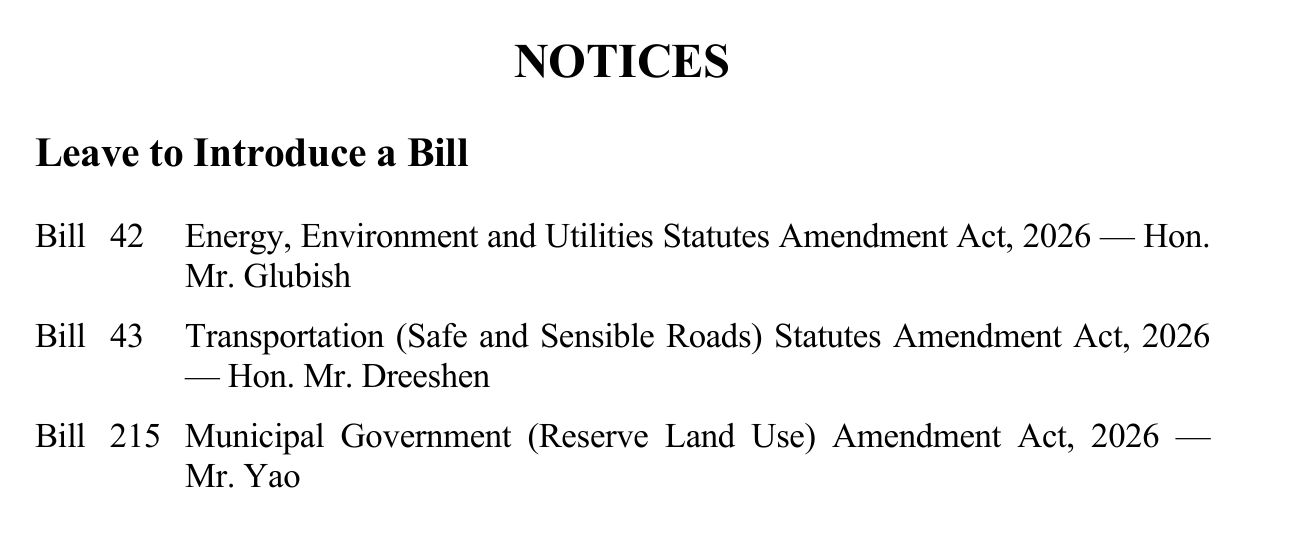
Notice of Bill 43 on the Legislative Assembly's order paper, Nov. 18, 2026.
People will die.
Devin Dreeshen is the most dangerous thing on Edmonton's roads. Road safety under the UCP essentially boils down to whatever the minister who resigned from cabinet over drinking in his legislature office wants.
His "Safe and Sensible Roads" Act will continue his trend of making our roads anything but.
This is our deal. We didn't vote UCP, we didn't worship at the ideological altar of his party, and now people are dying.
Pray he does not alter that deal further.
Get my news and takes in your inbox
Don't let algorithms control whether you see my latest video or article. We don't need to include Mark Zuckerberg in our relationship.
Free. Emails from Troy Pavlek when I publish something new. Unsubscribe any time.
That didn't go through. Try again in a minute, or email [email protected].
You're in. Thanks for subscribing!