Those celebrating the demise of Edmonton's zoning bylaw, are also celebrating the demise of local democracy.
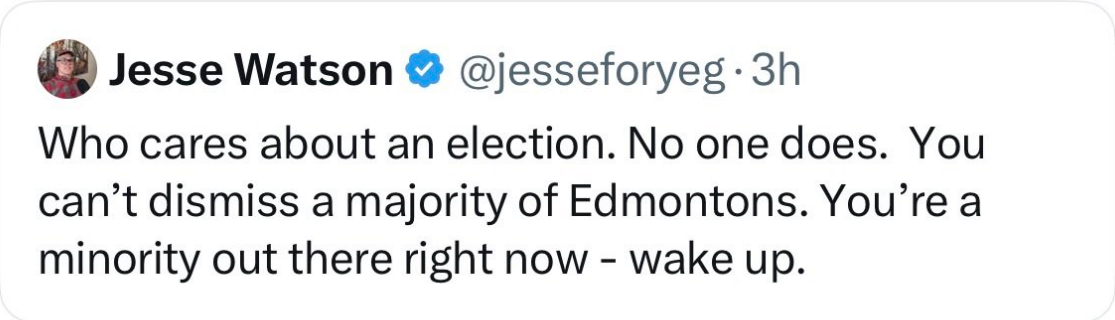
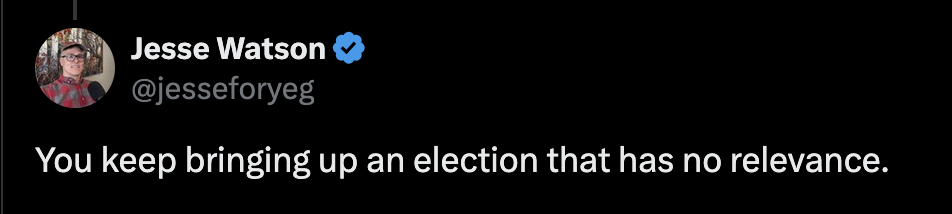
That's Jesse Watson, the anti-infill organizer whose agenda voters soundly rejected last October. Now that Danielle Smith is overturning local democracy to suit his preferences, he thinks the election doesn't matter and shouldn't be considered.
The province orders Edmonton to repeal its zoning bylaw
On October 8, Premier Danielle Smith took to a supporter's backyard to announce that Edmonton's zoning bylaw, passed in 2024 after years of extensive consultation, would be repealed by order of the Minister.
The City has 90 days to return to the zoning bylaw that existed pre-2024.
The new zoning bylaw was an extensive rewrite of the previous bylaw, which was originally envisioned in the 1960s when Edmonton was half the size and a very different city. The new zoning bylaw was simpler, easier to use and allowed for a wider variety of housing in established neighbourhoods, including small-scale infill developments of up to eight units on a single lot.
This comes as Minister Devin Dreeshen plans to table legislation to force Edmonton to halt construction and tear out existing bike lane infrastructure, showing a pattern of provincial interference in municipal matters.
This is the map Danielle Smith wants you to look at
Alberta: a sea of blue.
But give every riding the same size dot, and the story changes.
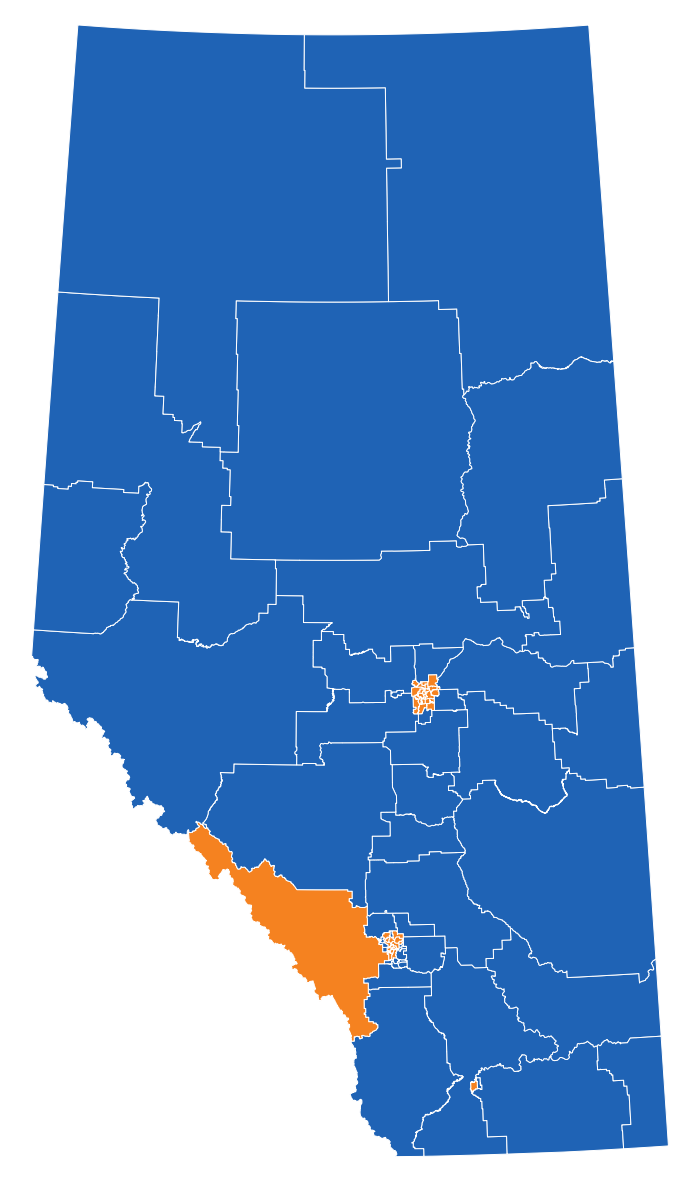
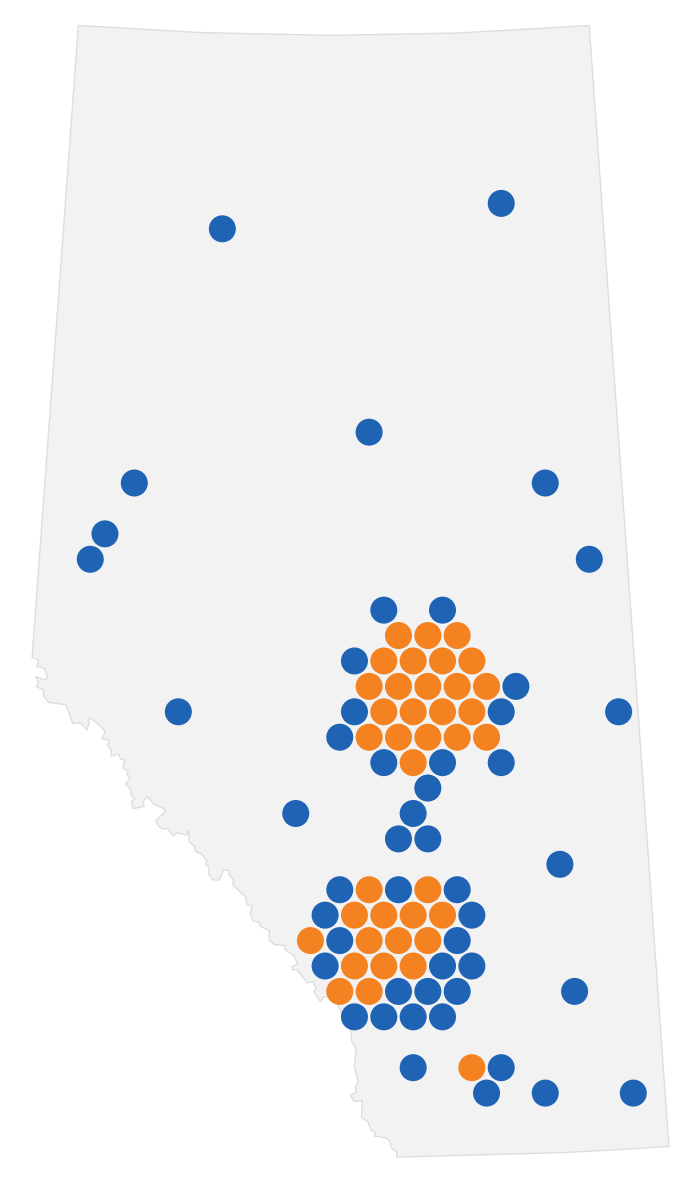
You'll hear people online calling Alberta the conservative "Texas North." Look at the map on the left and it's easy to see why. But land doesn't vote.
Count ridings instead of square kilometres and you get the map on the right. The UCP won 49 seats to the NDP's 38 in 2023, with about 53% of the vote. It's a majority, but a slim one and it doesn't accurately represent the ridings where people actually live: in cities.
Edmonton's central ridings, the ones with the most infill, were not competitive for the UCP. The NDP took Strathcona by about 10,900 votes, Gold Bar by 9,300 and City Centre by 8,300.
A map can make a narrow win look like a landslide, and it can make a local issue look like a citywide one.
Where infill actually happens
Here's a map of where infill permits were actually issued under Edmonton's new zoning bylaw. The one Danielle Smith is forcing City Council to repeal.
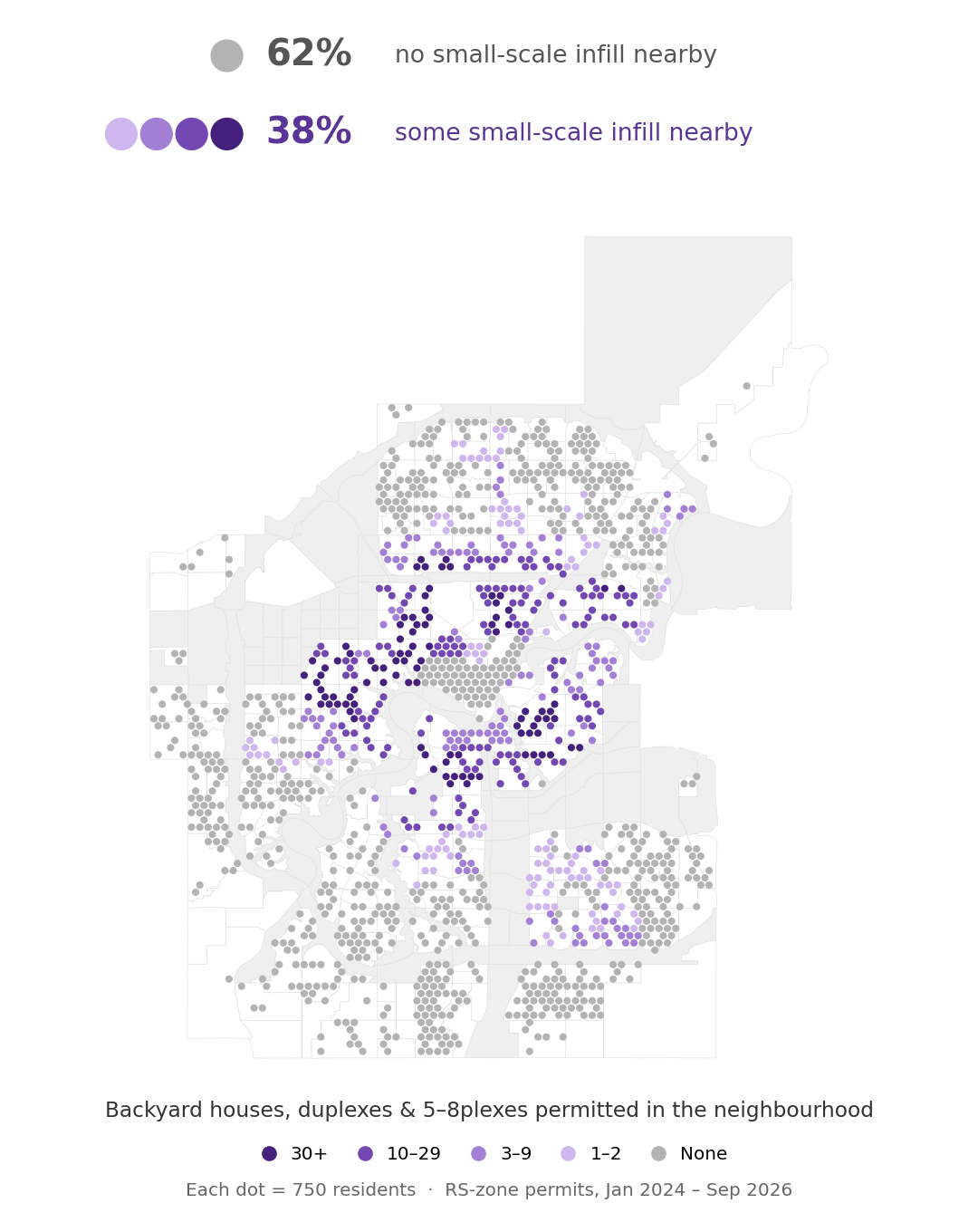
Since Edmonton's new zoning bylaw took effect in January 2024, about 62% of Edmontonians live in neighbourhoods that haven't had a single small-scale infill permit issued.
Each grey dot represents 750 people living in a neighbourhood where nothing has been permitted. The purple dots get darker the more projects there are.
"Small-scale infill" is the stuff this whole fight is about: backyard houses, duplexes up to fourplexes, and the 5 to 8-plexes going up on what used to be single-family lots. I didn't count someone tearing down a bungalow to build a bigger house, and I didn't count basement suites. (Nobody's lobbying the Premier about those.)
Even inside the purple 38%, it's not like there's a construction site on every block. Set the bar at five or more permitted projects in your neighbourhood instead of one, and the share of Edmontonians living in those neighbourhoods drops to about 23%.
And it's concentrated. 97.5% of small-scale infill is in the mature neighbourhoods. Between the mature neighbourhoods and the Henday, where about 400,000 people live, roughly one lot in 1,250 has had a permit for redevelopment.
Some of the highest concentrations of infill occur in papastew and Métis.
Papastew, where Janz, who makes no secret about his support for zoning and is as orange as they come, got over 57% of the vote.
And Métis, where Ashley Salvador, a constant proponent of urban design, zoning reform and effective density, got a commanding 48.5% of the vote.
Despite Edmonton Neighbourhoods United rallying during the election, and their registration as a Third Party Advertiser, their agenda was not reflected at the polls in any meaningful way.
For most of the city, this issue is not top of mind, and does not affect the neighbourhoods where most people live. For the areas that are affected more heavily, there's been a clear electoral mandate in support of infill redevelopment.
Voters have already made their voices heard
In last year's election, only about one in seven Edmontonians even called infill a top concern. Leger asked people to pick their top three priorities heading into the vote. Infill came 11th.
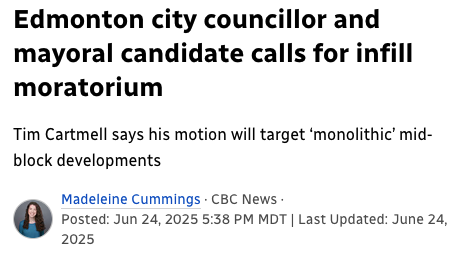
And the best-funded mayoral campaign in Edmonton's history, which called for a moratorium on infill, lost.
Tim Cartmell put a pause on infill at the centre of his pitch. He spent nearly $1.5 million doing it, and he still lost to a candidate he outspent six to one.
So they tattled to the Premier
Danielle Smith is now ordering Edmonton to tear up its zoning bylaw at the behest of her friends in Edmonton Neighbourhoods United. (ENU's Jaclyn Soroka was standing with the Premier at the announcement)

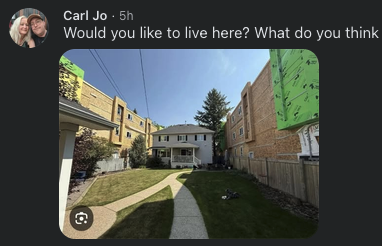
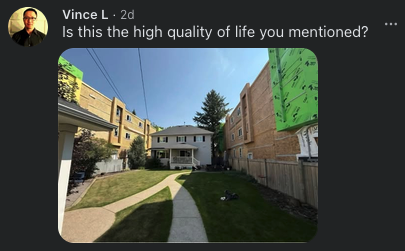
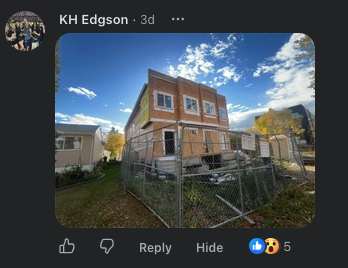
If you've read a comment section about infill on Facebook lately, you've (unfortunately) met ENU's supporters. They're the ones spamming the same three under-construction infill pictures under every post.
Their favourite is that one house in Crestwood, only taken from the back with a wide-angle lens and never showing the completed houses. It then got a starring role in the Premier's conference and messaging.
This campaign is being pushed by several of the losers from the last election, like Mark Hillman, Justin Thomas and Jesse Watson.
All three put their ideas in front of voters a year ago, and lost.
Mark Hillman ran in papastew and got 17% of the vote. Michael Janz won with 57%.
Justin Thomas ran in Métis and got 16% to Salvador's 48%.
Jesse Watson ran in Anirniq and got 30%, losing to Erin Rutherford.
ENU's own candidate scorecard rated Hillman and Thomas as the most aligned with its position. Voters knew what was on offer. Voters broadly rejected them and their agendas.
"Who cares about an election"
In the case of Jesse Watson, his take now is the one at the top of this post: the election didn't matter, and people who support infill are in the minority. He's doubling down on that, too.
Since losing the election, Watson has been playing this fast and loose, right-wing, Trump-style playbook that Canadian conservatives of this era love. He spreads reactionary misinformation to rile up anger and get engagement.

Alberta Radio Show posted that they'll be supporting him for a UCP nomination in Decore, so maybe "Conservative politician" is just the whole goal, anyway.
Local elections matter
Mayors Andrew Knack and Jeromy Farkas have both raised the alarm about the potential catastrophic implications of a Premier and cabinet directing local officials on how they can, and cannot, vote about municipal issues.
While the province has the legal authority to direct cities, that does not grant them a moral or democratic authority in the eyes of most residents and elected officials.
A loud group organizing Facebook spam for their own political benefit does not constitute a majority, or a mandate.
Contrary to what Jesse Watson and Danielle Smith believe, local elections still determine that mandate.